
Why Automotive Inventory Management Alone Won’t Fix Aging Inventory

Why Automotive Inventory Management Alone Won’t Fix Aging Inventory

Why Automotive Inventory Management Alone Won’t Fix Aging Inventory

Why Inventory Management Alone Won’t Fix Aging Inventory

Quick Takeaway:

Automotive inventory management helps car dealerships identify pricing, stocking, and aging inventory risks, but it does not solve the demand problem behind unsold vehicles. A vehicle can still sit on the lot even when it is correctly priced and well-managed if it is not reaching enough qualified shoppers. For dealerships, improving inventory turn requires more than management alone. It requires aligning inventory strategy with visibility, advertising, and vehicle prioritization so the units that need attention actually get seen in the market. The solution? Dealers United’s newest tool, InventoryIgnite.

Introduction: The uncomfortable truth about dealership inventory

Every dealership today is investing in automotive inventory management software.

From pricing tools to predictive AI platforms, the industry has never had more data, more dashboards, or more control over inventory. On paper, it should be easier than ever to stock the right vehicles, price them correctly, and turn inventory faster.

And yet the opposite is happening in many cases.

Vehicles are still aging. Margins are still shrinking. Price drops are still the default move when units don’t sell.

This isn’t a tooling problem. It’s a strategy gap.

Because while auto dealer inventory management has evolved rapidly, most dealerships are still solving only half the equation. They’ve become incredibly good at managing supply, but they haven’t adapted how they create demand.

And that’s why even the most advanced vehicle inventory management systems fail to fix aging inventory.

The current state of automotive inventory

To understand the problem, we have to look at what’s actually happening in the market right now.

  • U.S. dealerships are sitting on ~2.8 million vehicles, with about a 76-day supply on average
  • At the same time, inventory is aging and Days on Lot is rising in certain segments, forcing dealers into selective markdowns and incentives
  • Pricing strategies are becoming more surgical—but not necessarily more effective at moving units

current state of automotive inventory

And when vehicles age past 45–60 days, the pressure builds quickly. Dealers start making reactive decisions, like discounting, incentivizing, or wholesaling, just to free up cash flow.

The result is a cycle that looks like this:

  • A vehicle doesn’t sell
  • Price gets reduced
  • Margin erodes
  • Still doesn’t move fast enough
  • Vehicle eventually exits at lower profit or a loss

The industry has responded by investing heavily in auto inventory management systems designed to prevent this exact scenario. But those systems, while powerful, are not solving the root issue.

What dealership inventory management actually does well

Before pushing further, it’s important to be clear about the role auto inventory management plays.

Strong auto dealer inventory management is essential. It helps dealerships answer the questions that drive day-to-day operational success:

  • What vehicles should we stock?
  • Are we priced competitively?
  • Which units are at risk of aging?
  • Where are we over- or under-indexed in our inventory?

inventory management does well
Modern car dealership inventory management systems have made these decisions more data-driven than ever. Dealers can now spot risk earlier, react faster, and maintain tighter control over both inventory mix and pricing discipline.

That foundation matters. Without it, dealerships fall into reactive cycles like holding inventory too long, discounting too late, and ultimately giving up margin to correct avoidable mistakes.

But even the strongest inventory process has a limitation.

The problem: inventory management is inherently backward-looking

Even with AI, the most advanced automotive inventory management software is built on historical and comparative data.

It looks at:

  • what has sold before
  • how similar vehicles are priced
  • what competitors are doing

From there, it makes recommendations about what you should do next.

But it doesn’t answer the most important forward-looking question:

Who is actually going to see this vehicle?

That’s the gap.

Inventory management tells you how to optimize your inventory. It does not guarantee that your inventory will be discovered by the right buyers at the right time.

And in today’s market, discovery is everything.

Why great inventory management still leaves dealers exposed

This is where many dealerships get stuck.

Even with excellent automotive inventory management software, the system is primarily working from internal data and market comparisons. It can identify which vehicles are aging, which ones are overpriced, and which segments are underperforming.

But identifying a problem is not the same as solving it.

A dealership can have the right vehicle, at the right price, in the right market…

…and still watch it sit on the lot.

Not because the inventory decision was wrong, but because the vehicle never reached enough qualified shoppers.

That’s the part inventory management doesn’t control.

Automotive Inventory Ads almost close the gap, but not quite

At first glance, it might seem like dealerships have already solved this, because most stores are running dynamic automotive inventory ads.

Vehicles are fed into platforms, and VIN-level ads are automatically created and distributed. 

On paper, that connects inventory to demand.

But in practice, those systems are largely passive.

They rely on platform algorithms to decide which vehicles get the most visibility. And those algorithms are designed to optimize for engagement and efficiency, not dealership priorities.

So what actually happens?

  • High-demand vehicles tend to get more spend
  • “Easy” units continue to dominate impressions
  • And the vehicles that need help the most… often get very little

That’s why it’s not uncommon for a dealership to have vehicles sitting for weeks while receiving only a few dollars in ad spend. Not because they don’t matter, but because the algorithm doesn’t see them as efficient to promote.

Dealers aren’t lacking VIN-level advertising. They’re lacking control over which vehicles get attention.

automotive inventory ads lack control

That’s why platforms like InventoryIgnite exist.

With it, dealerships decide which vehicles deserve priority instead of leaving that decision entirely to the platform.

Instead of passively distributing ad spend across your inventory, InventoryIgnite allows dealerships to prioritize which vehicles get visibility based on real business goals, whether that’s aging units, underperforming inventory, or specific categories like EVs.

inventoryignite automotive inventory solution gif

InventoryIgnite is not a replacement for automotive inventory management software. It is the next layer after you have already identified which vehicles need more attention. In other words, if inventory management helps a store understand its supply problem, InventoryIgnite helps stores fix the demand problem that sits underneath it.

Rather than depending on invisible networks or black-box distribution, InventoryIgnite puts vehicle-focused advertising on Meta and Google, where real car shoppers are already researching and comparing options. Not random, third-party news sites.

The value here is not just channel choice. It’s control. Dealers can align their visibility strategy more closely with their unique inventory strategy, rather than hoping a broad campaign or a generic algorithm spreads attention evenly across the lot.

This is a much more practical extension of auto inventory management. The dealership identifies inventory priorities. The visibility layer helps act on them.

Inventory doesn’t just need exposure—it needs prioritization

Every vehicle on a lot is not equally important at any given moment.

Some units will sell quickly on their own. Others require more attention because they are aging, underperforming, or strategically important to the dealership’s goals.

Strong vehicle inventory management already identifies those differences. It tells you which vehicles need help.

But most dealerships still treat advertising as if all inventory should be distributed evenly.

That’s where the disconnect happens.

vehicle merchandising strategy

If a vehicle has been live for weeks and has only received a few dollars in ad spend, it hasn’t really been marketed. It’s just been listed.

Closing that gap requires a shift in approach.

Instead of equally feeding all used and new inventory into ad platforms, dealerships need to actively decide:

  • Which vehicles need more visibility right now
  • Which categories (like EVs or trucks) should be pushed based on store goals
  • Which units are underexposed relative to their importance
  • Where spend should be reallocated to drive movement

This is where marketing stops being a background function and becomes an operational lever tied directly to inventory performance.

The result is not more advertising for the sake of it. It’s more relevant visibility applied to the vehicles that need it most.

Where vehicle merchandising still fits

It’s also worth noting that visibility is only part of the equation.

Automotive Inventory Ads and InventoryIgnite alike still use photos to stop car shoppers from scrolling.

And once a shopper lands on a vehicle, presentation still matters. Additional photos, videos, descriptions, and VDP quality all play a role in converting interest into action. That’s where traditional vehicle merchandising continues to be important.

But merchandising alone cannot solve the aging inventory problem.

A perfectly merchandised vehicle that no one sees will still sit unsold. Visibility gets the shopper there. Merchandising helps close the deal.

The two are complementary, but they solve different parts of the same problem.

What dealers should do differently

For dealerships looking to improve car dealership inventory management outcomes without relying solely on price reductions, the path forward is not more tools. It’s better alignment, and better tools.

Start by maintaining a strong inventory foundation. Continue using automotive inventory management software to guide acquisition, pricing, and risk management.

Then, extend that strategy into visibility.

Make sure your marketing is not just running, but working in alignment with your inventory priorities. Run your dynamic AIA for all new and used vehicles, but go one extra step and identify which vehicles need more attention. Ensure they are actually receiving meaningful exposure, not just being included in a feed.

Pay attention to where ad spend is going. If certain vehicles consistently receive minimal spend despite needing to move, that’s a visibility gap in your ad strategy.

Most importantly, take back control of prioritization. Don’t rely entirely on platform algorithms to decide which vehicles matter. Your inventory strategy should drive your visibility strategy, not the other way around. Your “on-lot” sales goals should drive your ad strategy. 

The bottom line

Dealerships absolutely need strong automotive inventory management software. They need better pricing discipline, smarter acquisition, and clearer insight into which units are at risk.

But inventory management alone is not enough.

It tells you what needs to happen.
It does not make it happen.

In many cases, dealerships already know which vehicles need help. What they lack is a way to ensure those vehicles actually get the attention they deserve in the market.

That’s the gap solutions like InventoryIgnite are built to close: connecting inventory insight with real-world visibility, and allowing dealers to prioritize the vehicles that matter most instead of leaving that decision entirely to platform algorithms.

So if your strategy stops at inventory management, you’re not managing inventory, you’re managing stagnation.

The dealerships that win moving forward will be the ones that connect both sides of the equation—those that combine strong auto dealer inventory management with intentional, VIN-level demand creation.

Because at the end of the day, the goal isn’t just to manage inventory.

It’s to move it.

DU Master Featured images Dealers United 68

Lauren circle 200x200 1

Written By Lauren Blackwell
Lauren Blackwell is a skilled content marketer who has spent the past 3 years working in automotive advertising technology and now brings her unique experiences to Dealers United. From running ad campaigns, to curating auto-specific resources, Lauren is empowered to create valuable content to help automotive dealers thrive on social media.

Vehicle Inventory Low? 4 Ideas To Source and Re-Stock On The Models You Want (Without Going To Auction)

Vehicle Inventory Low? 4 Ideas To Source and Re-Stock On The Models You Want (Without Going To Auction)

Vehicle Inventory Low? 4 Ideas To Source and Re-Stock On The Models You Want (Without Going To Auction)

While consumer confidence continues to rise and more positive indicators for the auto industry are revealed each week, another challenge is starting to emerge for dealerships:

…diminishing inventory. 

vehicle inventory low 2020 ideas to restock

Since vehicle factories and auctions have been closed or suspended over the last few months, many dealers are now worried that they will not have enough inventory to sell as demand continues increasing.

According to Cox Automotive, “new-vehicle inventory is low – less than 3.3 million vehicles by last count, the lowest volume in more than a year.” This puts a significant pinch on high-demand vehicles like SUVs and trucks.

Here are a few solutions your dealership can explore to replenish your inventory immediately and cost-effectively. 

Stock Up On Used Inventory By Going Direct-To-Consumer

Used inventory is an important part of any dealership’s business, but with most dealers relying on auto auctions and trade-ins, supply has come to a screeching halt.

Dealers have calculated costs upward of $1,500 to acquire a vehicle at auction. Factors include auction fees, transportation fees, and depreciation. Not to mention you’re dependent on the inventory selection, times to buy, and delivery schedules that could impact your floor plan.

Instead, dealers should look to source vehicles directly from consumers. Here’s how:

Idea #1: Buy Back Campaigns

A lot of people are looking to sell their vehicles right now, or maybe even just get out of an intimidating payment. 

Use IHS Markit data from Oracle Data Cloud to specifically target owners of desirable model lines your dealership wants. You can even narrow down targeting to owners of Makes, certain Models, and even how long they’ve owned their vehicle.
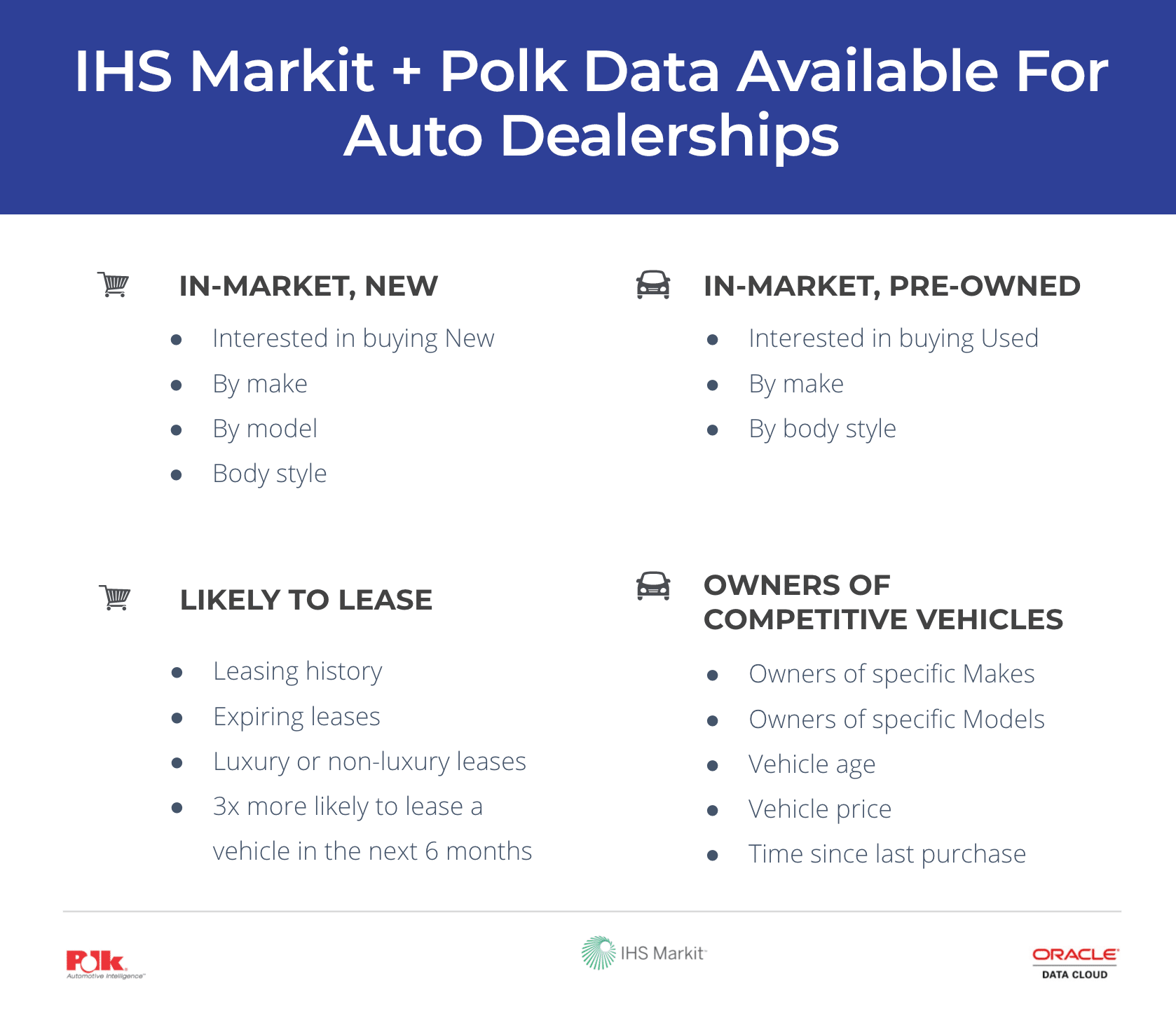
ihs markit polk data for auto dealerships oracle

Then, run a straight Buy Back campaign on Facebook telling consumers that you’ll offer them a great price to buy back their vehicle, and that you’ll take their vehicle even if they don’t buy their next car from you!

dealership buy back campaign facebook ad cash offer

Idea #2: Oil Change Special

Present an irresistible oil change offer targeted at specific model line owners.

Build a Facebook Custom Audience consisting of your customers who haven’t purchased or recently, or use Oracle 3rd party data and find owners of the makes you want to show them the offer!

Use a unique price point like “$9.99” to easily track where your service business is coming from and to alert your team to inspect the vehicle while it’s on the lift. If it’s what you’re looking for, make an offer to put them in a new vehicle.
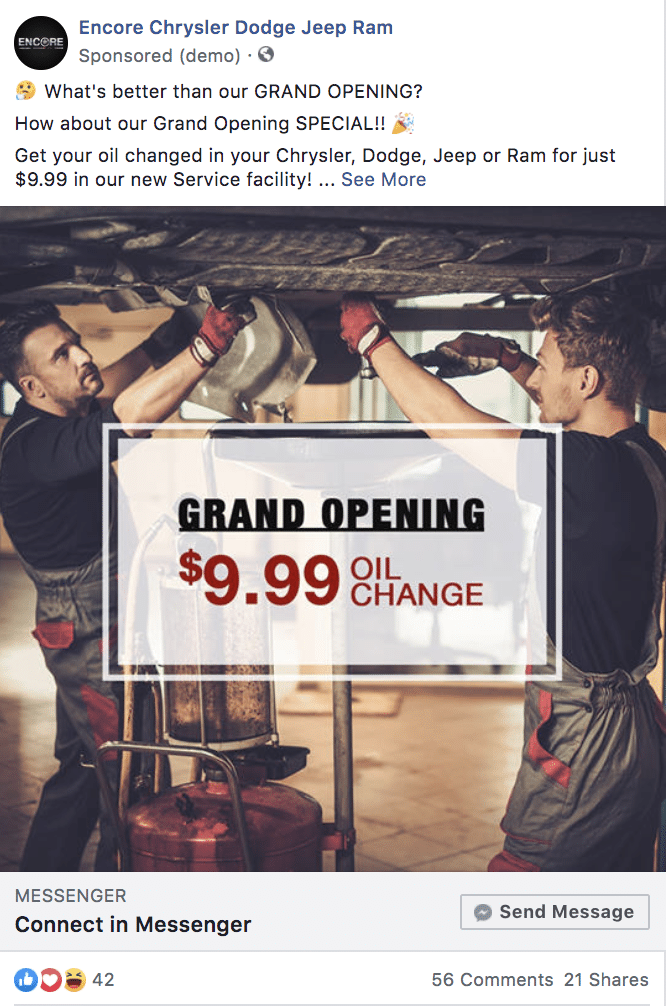
oil change offer facebook ad

This strategy is a great way to bring in brand defectors who live in your PMA/AOR and are not currently buying from you.

Idea #3: Trade-Up Campaign

Many vehicle owners simply want to stay in the model they’re in already. 

You can run a “trade keys” campaign to allure targeted model line owners to trade their vehicle in for a new model, giving you a desired used unit that you can add to your CPO or used inventory.

Deliver ads showing your easy Trade-In calculator that they can complete from the comfort of their home, or run ads showing exactly which body style (Truck/SUV/Car) you’re looking for.
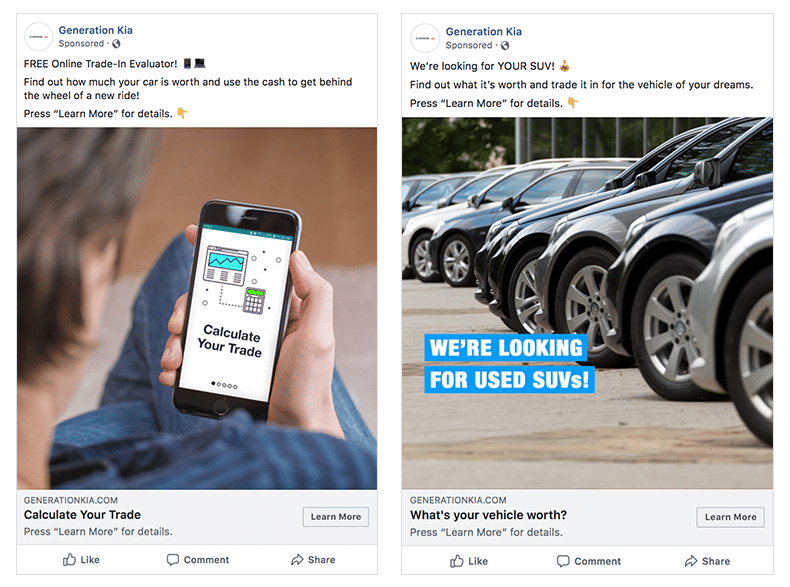
buyback ideas auto dealers 2020 b

Idea #4: Advertise What You Have

While there isn’t much you can do about your OEM’s new vehicle supply, there are ways you can maximize and quickly move the inventory that you do have on your lot.

Using Facebook Automotive Inventory Ads (AIA), you can display your live, on the ground inventory to in-market shoppers. 

Look at your SRP’s and heaviest grouped models and budget a larger amount for those units that your dealership has a surplus of.
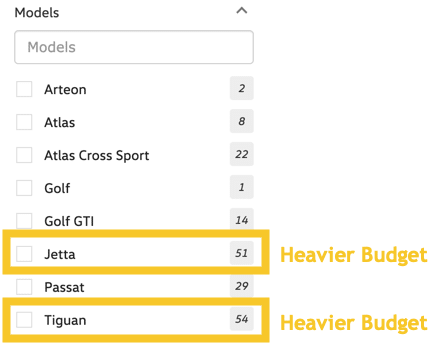
restocking vehicle inventory guide dealerships

Prospect shoppers with your live inventory and then retarget browsers of your lower stock inventory to show them what you have available. 

Since customer safety is still key, be sure to explain what remote offers you have, like at-home test drives and deliveries. 


Layer your “Why Buys,” or why they should buy from your dealership and what sets you apart, into your ad copy. 

Lastly, display and double down on your OEM’s incentives to show shoppers that right now is a great time to buy!
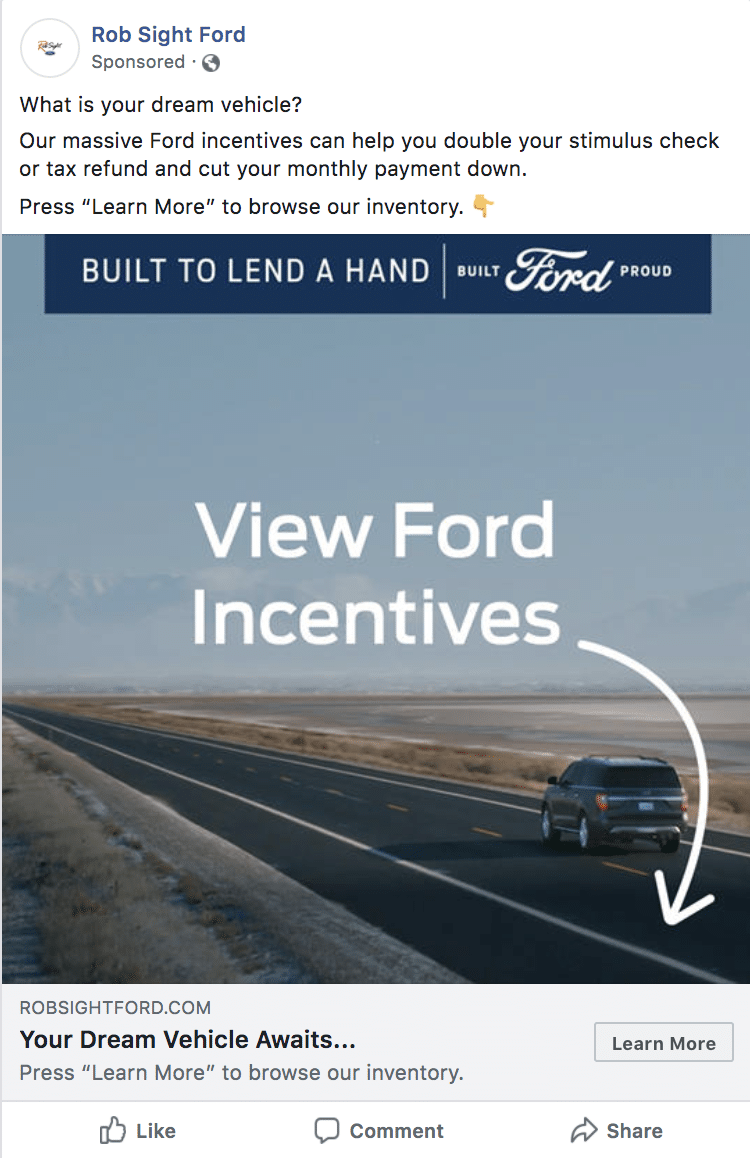
maximize oem incentives post covid19

Recap: A Targeted Facebook and Instagram Inventory Buy Back Strategy

Facebook and Instagram paired with Oracle Data are great tools to get out in front of audiences where they are spending their time right now. 

Reach users who are willing to sell their vehicles to get much needed inventory for your dealership, display oil change and trade up offers with the intention of getting desirable units, and prioritize advertising the inventory you have on the lot now. 

Shopper demand continues to grow after the effects of COVID-19. Be sure that you have the models they want, before they defect to your competitor.

If you need help using Facebook and Instagram to source and re-stock your vehicle inventory, schedule a strategy call with us here. 

Blog Author - Drew Detweiler

Written By Drew Detweiler
Drew manages inbound and outbound marketing for Dealers United. When he’s not at work, he’s probably enjoying the outdoors, fishing, or eating.

[ANSWERED] How Dealers Can Post Vehicles Into Facebook Marketplace For Free

[ANSWERED] How Dealers Can Post Vehicles Into Facebook Marketplace For Free

[ANSWERED] How Dealers Can Post Vehicles Into Facebook Marketplace For Free

Quick Answer: How to Post Vehicles Into Facebook Marketplace For Free

Car dealers can post vehicle inventory to Facebook Marketplace for free by connecting their dealership’s Facebook Page to Marketplace and syncing inventory through a third-party feed provider or by uploading vehicles manually. With millions of car shoppers browsing Marketplace daily, listing your inventory there is one of the lowest-cost ways for dealerships to generate leads from buyers who are already actively searching on Facebook.

Facebook is changing the automotive classifieds listing landscape with their new platform, Facebook Marketplace. Keep reading to learn why you should list your inventory on Marketplace, how Marketplace stacks up against other classifieds players, and the answer to the question: How to post vehicles into Facebook Marketplace for free!

Read it!

How Your Dealership Can Get 662% More Craigslist Sales Leads (Almost) Overnight

How Your Dealership Can Get 662% More Craigslist Sales Leads (Almost) Overnight

How Your Dealership Can Get 662% More Craigslist Sales Leads (Almost) Overnight

HINT: Stop showing price! When it comes to listing vehicle prices on your website, you’ve likely had to decide whether to list MSRP, ask visitors to complete an ePrice request, use a 3rd party pricing tool, or a combination of all three. But what about showing price on sites like Craigslist? We’ve been urging dealers to STOP showing price on their Craigslist inventory ads, and we’ve seen their results skyrocket (nearly) overnight.

Read it!

What’s Really Happening On Your Dealership’s 3rd Party Listings (And How To Stop It)

What’s Really Happening On Your Dealership’s 3rd Party Listings (And How To Stop It)

What’s Really Happening On Your Dealership’s 3rd Party Listings (And How To Stop It)

How valuable are 3rd party leads to your dealership? Whether you think dealers need 3rd party sites or not, I’ll wager you value ANY lead you’re paying good money for. But what if those leads were being “stolen” right from under your nose? Here’s what you ought to know about the 3rd party sites your dealership is using (and how to put a stop to it).

Read it!

What Does The 2017 Auto Market Slowdown Mean For Your Dealership? (No Really, I’m Asking You)

What Does The 2017 Auto Market Slowdown Mean For Your Dealership? (No Really, I’m Asking You)

What Does The 2017 Auto Market Slowdown Mean For Your Dealership? (No Really, I’m Asking You)

If you’re a glutton for auto industry news like I am, I’m sure you’ve seen a volume of articles around “2017 auto sales plateaus,” “new vehicle slow downs,” and “auto cycles ending” over the last few months.

Read it!